
Home Gym Ideas That Fit Your Space, Budget, and Routine
Estimated reading time: 11 minutes
A useful home gym starts with the workout you’ll actually do—not a room full of equipment. If you want to build strength in a spare corner, a clear floor area, resistance bands, and a pair of dumbbells may be enough. If your main goal is walking more, you might need comfortable shoes and a reliable outdoor route rather than a treadmill.
The best home gym ideas solve a specific problem: limited space, noisy workouts, equipment that takes too long to unpack, or a routine you can’t comfortably do at home. Start with that problem, then buy only what helps.
Choose your workouts before choosing your equipment
Before shopping, write down three things:
- What you want to do: Strength training, indoor cardio, balance work, or a mix.
- Where you’ll do it: A shared living room, bedroom corner, garage, or dedicated room.
- What you can realistically maintain: Include setup time, storage, and your schedule—not just the purchase price.
For example, imagine you want two short strength sessions each week and already enjoy walking outside. Bands and dumbbells could fill the missing part of your routine. A large cardio machine might add cost without solving a problem.
For general health, the World Health Organization recommends adults get at least 150 minutes of moderate-intensity aerobic activity, or 75 minutes of vigorous activity, each week, plus muscle-strengthening activity involving all major muscle groups on at least two days. Those are activity targets, not a shopping list. You don’t need machines to work toward them, and beginners can build up gradually.
Five home gym setups for different spaces
1. A pack-away gym for a living room or bedroom
If the room has another job, make your gym easy to remove.
Start with a mat if your exercises need one, a resistance band, and a stable chair. Add dumbbells when you have a secure place to store them. A basket can hold lightweight accessories, but keep heavier equipment low and out of walkways.
Try the complete setup before buying anything: move the furniture, lay out your exercise area, and rehearse the movements you plan to do. Can you reach overhead without hitting a light? Step backward without catching the rug? Lie down without blocking a doorway?
The useful measurement is your movement space, not just whether a mat fits.
2. A strength-training corner
A strength corner works well when you want equipment ready without giving up an entire room.
Dumbbells or resistance bands can support pushing, pulling, squatting, and hip-hinging exercises. A sturdy chair can help with sit-to-stands or provide support for some movements. You don’t need a bench immediately if your chosen routine works without one.
Keep equipment close enough to use, but not underfoot. If adjustable dumbbells appeal to you, check their weight range, adjustment method, and locking instructions. Compact equipment only helps if you can handle and store it safely.
3. An indoor cardio station
A stationary bike, treadmill, or rowing machine can be useful when weather, darkness, or other constraints make outdoor activity difficult.
Choose around the activity you’re willing and able to repeat. Then check the manufacturer’s operating clearances, power requirements, access needs, and storage instructions. A folded machine’s dimensions don’t tell you how much room it needs during use.
Don’t feel obliged to buy one. Brisk walking is a recognized moderate-intensity activity, and an outdoor walking routine may leave more space and budget for strength equipment.
4. A shared household workout area
In a family home, storage and access control matter as much as the exercise selection.
Keep weights secure, bands out of children’s reach, and moving machinery inaccessible when it isn’t in use. The TÜV Association warns that treadmills, rowing machines, and stationary bikes can pose risks to young children. An idle machine shouldn’t be treated as harmless play equipment.
If you can’t reliably separate children or pets from a moving machine, a pack-away setup may be the more practical choice.
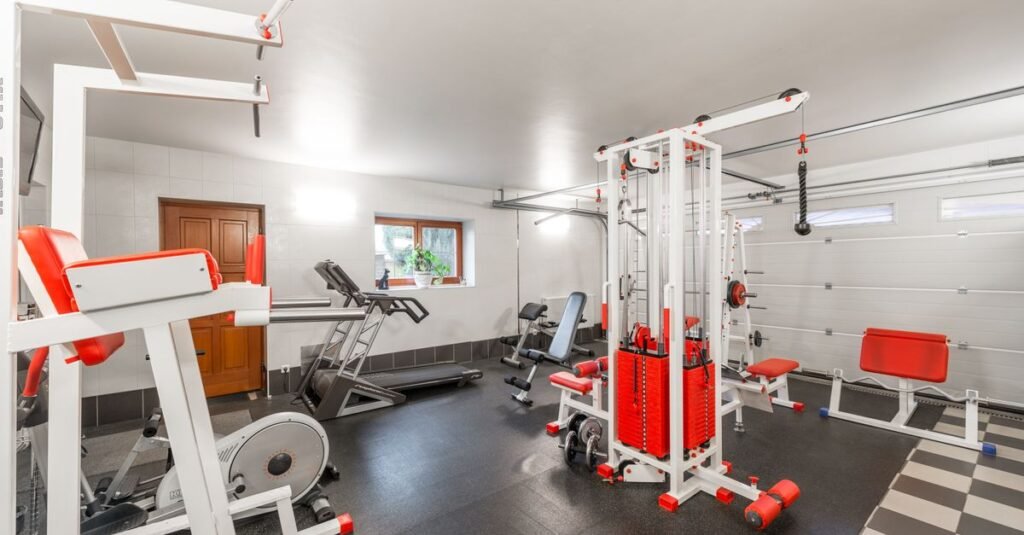
5. A dedicated spare-room or garage gym
More room gives you options, but it doesn’t create a reason to fill every wall.
Set aside clear movement space first. Then place equipment around the workouts you’ll perform. A dedicated gym still needs a stable, level surface, unobstructed access, and appropriate equipment clearances.
For a garage, consider whether temperature, moisture, lighting, and storage conditions suit both you and the equipment. Don’t assume a protective mat makes every floor suitable for heavy loads. Check relevant equipment guidance and get qualified advice if the floor’s capacity is uncertain.
What to buy first—and what can wait
No particular equipment bundle is proven best for everyone. Use this comparison to match purchases to a real need.
| Option | Useful when… | Main limitation |
|---|---|---|
| Bodyweight exercises | You want to start without spending or storing equipment | Some movements, especially pulling exercises, are harder to arrange |
| Resistance bands | You need portable, compact resistance | Bands need inspection, and anchored exercises require a suitable attachment |
| Fixed dumbbells | You want straightforward resistance with no adjustment mechanism | Multiple weights take up space |
| Adjustable dumbbells | You want several resistance options in a smaller footprint | Adjustment and locking systems vary |
| Exercise mat | You want a more comfortable surface for floor exercises | It doesn’t replace stable flooring or make every movement safer |
| Cardio machine | You have a clear reason to exercise indoors | Cost, operating space, maintenance, and safety requirements |
Bands versus dumbbells
Bands are easy to store and useful for many strength movements. Their resistance changes as they stretch, and setup affects how an exercise feels. Check them for tears, cracks, or other damage, and follow the manufacturer’s instructions for anchoring.
Dumbbells offer a clearly stated load and work well for movements such as squats, rows, presses, and hip hinges. Their main trade-off is storage: one pair may eventually be too heavy for one exercise and too light for another.
You don’t have to choose permanently. Start with whichever fits your routine and space, then add the other if you identify a specific gap.
Buy to remove a limitation
A sensible buying order is:
- Try a basic routine using what you already have.
- Identify the exercise or practical problem you can’t solve comfortably.
- Buy the smallest useful addition.
- Use it consistently before expanding.
For instance, if you can already do chair squats and wall push-ups but have no practical pulling exercise, a suitable band setup may be more useful than another mat or a larger machine.
Make the room easy to use safely
A workout space should be ready without becoming a permanent obstacle course.
Keep frequently used items accessible, store weights securely, and move cables out of walking routes. Choose a stable, level, nonslip surface. If you use a chair for exercise, it should be sturdy and unable to slide or roll during the movement.
Before each session, make a quick check:
- Is the floor clear of toys, loose rugs, and equipment?
- Are bands, cables, and attachments undamaged?
- Are adjustable parts locked and fasteners secure?
- Is there enough clearance for the full movement?
- Are children and pets safely away?
Follow assembly instructions and inspect equipment periodically rather than waiting for something to feel loose. For motorized equipment, learn the stop controls, use supplied safety devices, and wait until the machine has stopped before stepping off.
A screen can help you follow a workout, but position it so you don’t have to twist to see it. Avoid letting entertainment distract you from moving equipment or what’s happening around you.
Give your setup a practical test with basic movements
You don’t need a complicated workout to discover whether your space works. The following examples show how a small setup can support several major movement patterns. They’re options, not a routine everyone must perform.
Sit-to-stand or chair squat
Use a stable chair on a nonslip surface. Place your feet comfortably apart, lean forward slightly from the hips, and stand with control. Sit back down without dropping into the seat.
For an easier version, use a higher, stable seat or appropriate hand support. Progress only when you can control both directions; adding weight isn’t the first priority.
Wall push-up
Place your hands on a wall around chest height. Step back, keep your body aligned, and bend your elbows to bring your chest toward the wall. Push away without letting your hips sag.
Standing closer makes it easier. A lower hand position on a secure raised surface can make it harder, but avoid lightweight furniture that could tip or slide.
Supported dumbbell row
With one hand supported on a sturdy surface, hinge forward at your hips and hold a light dumbbell in the other hand. Pull your elbow back without twisting your torso, then lower with control.
Use less weight or a more upright position if you can’t stay steady. The support surface needs to be stable; improvised furniture isn’t automatically suitable.
Unloaded hip hinge
Stand with your knees slightly bent and move your hips backward while allowing your torso to tip forward. Keep the movement comfortable and controlled, then stand tall.
Start without weights. If the motion is unfamiliar, learning it with qualified instruction may be more useful than trying to load it immediately.
For general beginner resistance training, the American Council on Exercise describes one to three sets per exercise, eight to 15 repetitions, and roughly two to three minutes of rest as useful starting guidance. These aren’t universal prescriptions. Appropriate exercise choices and amounts depend on experience, health, and goals, and a complete routine should cover the major muscle groups.
Plan progression instead of buying heavier equipment immediately
When an exercise becomes easier, you have several options: add repetitions within your chosen range, add a set, increase resistance, or choose a harder variation.
Change one thing at a time so you can judge how it affects your control and recovery. University of Arizona Extension guidance emphasizes gradual progression and proper technique. A heavier load isn’t progress if it makes you rush, twist, or lose balance.
Likewise, don’t judge a setup by how exhausted it makes you. It should let you exercise consistently with movements you can control.
A simple weekly arrangement could put strength sessions on two nonconsecutive days and spread walking or other aerobic activity across the week. Keep equipment setup brief enough that it doesn’t consume the time you meant to spend exercising.
Start with one workable corner
Before ordering equipment, clear your proposed space and rehearse a few movements without weights. Check reach, footing, storage, and how long setup takes. Then write down the first two sessions you intend to do.
Buy only what those sessions genuinely require. That gives every item a job—and leaves room to adjust your home gym as you learn what you’ll actually use.
This article provides general educational information. Health conditions, significant pain, balance concerns, or uncertainty about exercise technique may call for individualized professional advice. Stop exercise that causes unusual pain or discomfort and seek appropriate medical guidance.
Frequently asked questions
How much space do I need for a home gym?
The space you need depends on the movements and equipment you plan to use. Check that you can complete each movement with room to reach, step, and lie down as needed. The useful measurement is your movement space, not just whether a mat fits.
What equipment should I buy first?
Start by trying a basic routine with what you already have. Identify an exercise or practical problem you can’t solve comfortably, then buy the smallest useful addition. A mat, resistance band, stable chair, or dumbbells may suit different routines and spaces.
Are bands or dumbbells better for a home gym?
Neither option is best for everyone. Bands are portable and compact, while dumbbells provide a clearly stated load. Choose the option that fits your routine and space, and add the other only if you identify a specific gap.
Do I need a cardio machine to meet aerobic activity targets?
No. Brisk walking is a recognized moderate-intensity activity, and you don’t need machines to work toward general activity targets. An outdoor walking routine may leave more space and budget for strength equipment.
How can I make a home workout area safer?
Keep the floor clear, store weights securely, inspect bands and attachments, make sure adjustable parts are locked, and allow enough room for the full movement. Keep children and pets safely away from moving machinery and follow the manufacturer’s instructions.