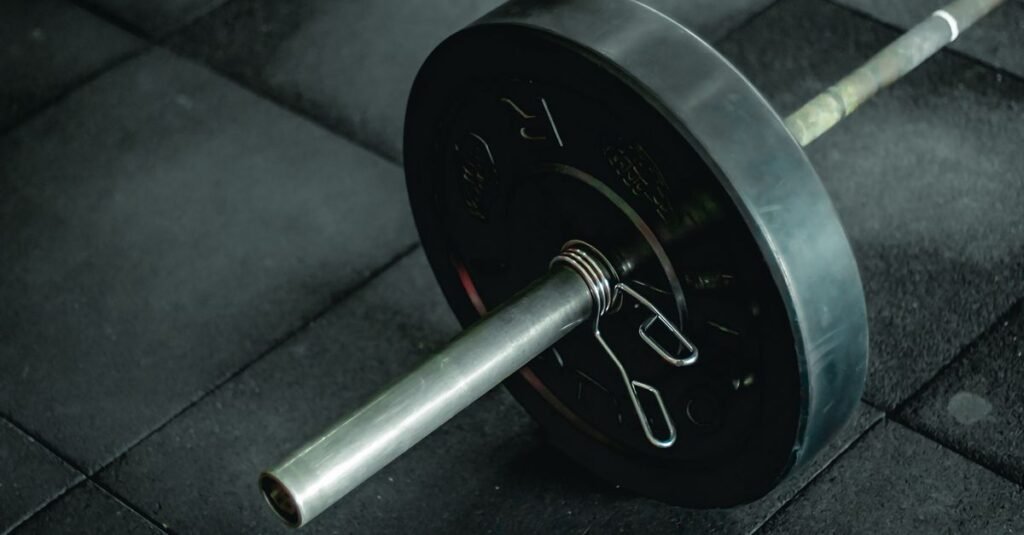

How Heavy Is the Bar at the Gym? How to Check and Count It
Estimated reading time: 9 minutes
Table of Contents
- Common Gym Bar Weights at a Glance
- Does the Bar Count Toward the Weight You Lift?
- Why “20 kg” and “45 lb” Aren’t Exactly the Same
- How to Find Out What Your Gym’s Bar Actually Weighs
- What Different Bar Types Tell You—and What They Don’t
- How Heavy Is a Smith Machine Bar?
- Mistakes That Make Your Workout Log Misleading
- Before Your Next Set
- FAQ
Common Gym Bar Weights at a Glance
Use these figures as a starting point, not as a guarantee for every bar in your gym.
| Bar type | Common weight or useful guidance |
|---|---|
| Full-size Olympic bar | Typically 20 kg, approximately 44 lb; often called a 45-pound bar |
| Women’s Olympic bar | Typically 15 kg, approximately 33 lb |
| Technique or light training bar | Often around 5–10 kg, depending on the model |
| Standard bar | Varies; don’t apply the 20 kg assumption |
| EZ-curl bar | Varies by model; check the marking or equipment specifications |
| Trap or hex bar | Varies by design and model |
| Safety-squat bar | Varies by design and model |
| Smith machine bar | Effective starting resistance depends on the machine and its counterbalance |
The important distinction is between a common specification and the actual piece of equipment in front of you. A typical Olympic bar has a familiar weight. “A bar at the gym” could describe several very different things.
Does the Bar Count Toward the Weight You Lift?
Yes. Your total barbell load includes the bar plus all the plates attached to it. Collars also add weight, although their contribution depends on the type.
The calculation is:
Total load = bar weight + plates on both sides + collars, if included
For example, if you put one 10 kg plate on each side of a 20 kg bar:
- Bar: 20 kg
- Left plate: 10 kg
- Right plate: 10 kg
- Total: 40 kg before collars
You’re lifting 40 kg, not 20 kg. The plates account for only half the load in this example.
That distinction matters especially when you’re starting out. An empty 20 kg bar is already a meaningful load; it isn’t a weight-free warm-up tool.
Count both sides, not just one
When someone says they bench press 60 kg, they generally mean the complete barbell load—not 60 kg of plates plus the bar.
With a 20 kg bar, reaching 60 kg requires 40 kg of plates in total, or 20 kg on each side.
If you’re working backward from a target weight, use:
Plate weight per side = (target total − bar weight) ÷ 2
For a 50 kg target using a 20 kg bar:
(50 − 20) ÷ 2 = 15 kg per side
This calculation leaves out collar weight. If your collars have a known weight and you want to include them, subtract their combined weight before dividing the remaining plate load between the two sides. Load the bar evenly and use appropriate collars to secure the plates.
Why “20 kg” and “45 lb” Aren’t Exactly the Same
A 20 kg bar weighs approximately 44.1 lb. A bar manufactured to weigh 45 lb weighs approximately 20.4 kg.
They’re close, which explains why “45-pound bar” is often used casually for a full-size gym bar. But the labels aren’t mathematically interchangeable.
For ordinary workout tracking, the useful habit is to record the bar’s stated weight and keep your units consistent.
For example:
- A bar marked 45 lb, plus one 45 lb plate on each side, totals 135 lb.
- A bar marked 20 kg, plus one 20 kg plate on each side, totals 60 kg, or about 132.3 lb.
Those setups look similar, but they aren’t identical.
You don’t need to calculate every session to a decimal place. You do need to avoid switching between pounds and kilograms as though the numbers mean the same thing. This becomes more noticeable when you move between gyms or compare records kept in different units.
How to Find Out What Your Gym’s Bar Actually Weighs
1. Check the ends of the bar
Look at the end caps—the circular ends of the bar—and around the sleeves or collars for a stamped, engraved, or printed weight.
You might see “20 kg,” “15 kg,” or a weight in pounds. A brand name or model number can also help staff identify it.
An explicit weight marking is the best quick check. Not every bar has one, though, and markings can become worn. If you can’t find a readable weight, don’t turn a visual guess into a definite number in your training log.
2. Ask about the specific bar
If the gym has several bars, point out the one you’re using. “How much does this bar weigh?” is more useful than “How much do your bars weigh?”
Staff may know the model or be able to check its specifications. This is particularly helpful for specialty bars, which can look broadly similar while having different weights.
It’s worth asking which lighter bars are suitable for the rack or exercise you plan to use. A shorter bar isn’t automatically a suitable replacement for a full-size bar in every setup.
3. Weigh it only if there’s a suitable, safe setup
A suitable scale can settle the question when markings and equipment information aren’t available.
One possible method is to weigh yourself, then weigh yourself holding the bar, and subtract the first reading from the second. But this only helps if the scale reliably registers the difference and you can hold the bar safely without it touching anything.
A long bar, cramped floor space, or an unsteady stance makes that a poor experiment. Don’t balance a bar awkwardly on a bathroom scale or climb onto a scale with more weight than you can comfortably control. Ask staff for help instead.
4. Record the bar alongside the load
A note such as “40 kg total, 20 kg straight bar” is enough to make your record clearer.
This matters if you alternate between bars. A 15 kg bar with 10 kg per side totals 35 kg; a 20 kg bar with the same plates totals 40 kg. If you record only the plates, you miss that difference.
What Different Bar Types Tell You—and What They Don’t
Olympic bars
In a gym context, an Olympic bar generally has rotating sleeves that accept plates with roughly 50 mm center holes. The sleeves are the thicker sections at each end where you load the plates.
A typical 20 kg bar is about 2.2 meters long, with a shaft around 28–29 mm in diameter. The shaft is the central section you grip.
Those dimensions can help you recognize the type, but “Olympic” doesn’t mean every bar weighs 20 kg. Other Olympic-style bars accept the same plates while having a different starting weight.
Women’s Olympic bars
A typical women’s Olympic bar weighs 15 kg, is approximately 2.01 meters long, and has a thinner shaft of roughly 25 mm.
The name describes a bar specification, not a rule about who may use it. The thinner grip and lower starting weight may suit a range of lifters.
If a 20 kg bar is too heavy for controlled practice, a 15 kg bar may be an option. But it’s still 15 kg; it isn’t necessarily light enough for every beginner or every exercise.
Technique and training bars
Light technique bars may weigh around 5–10 kg. They can provide a lower starting load when a full-weight bar is more than someone can comfortably control.
Check the particular model before adding plates. A lighter bar shouldn’t automatically be treated as a full-weight Olympic bar with the same intended use or loading capacity.
Standard, curl, trap, and safety-squat bars
“Standard bar” doesn’t give you one dependable weight. Neither do “EZ-curl bar,” “trap bar,” or “safety-squat bar.”
An EZ-curl bar has bends that change the available grip positions. A trap bar, also called a hex bar, lets you stand inside its frame. A safety-squat bar commonly has padding and handles that change how it sits on your shoulders.
Their different shapes are easy to recognize. Their weights are not. Check each model rather than borrowing a figure from a different gym or an online chart.
How Heavy Is a Smith Machine Bar?
A Smith machine doesn’t have one universal bar weight.
Its bar moves along a guided track, and some machines use a counterbalance that offsets part of the bar assembly’s weight. That means the metal bar’s physical weight may not equal the effective starting resistance you feel before adding plates.
Look for a starting-resistance label on the machine or ask staff to check the manufacturer’s specifications. Don’t automatically enter 20 kg or 45 lb.
For tracking, record both the machine and its stated starting resistance. If that resistance is unknown, you can still note the plates you added, but label the entry clearly—for example, “Smith machine, 20 kg of plates added; starting resistance unknown.”
Also keep Smith machine records separate from free-bar records. The guided movement and machine mechanics mean equal-looking numbers aren’t a direct comparison.
Mistakes That Make Your Workout Log Misleading
The biggest mistake is assuming every straight bar is 20 kg. A gym may keep 15 kg bars and light training bars beside full-weight bars.
Other easy traps include:
- Judging by color or grip markings. These may help distinguish bars, but there’s no dependable visual rule across brands that confirms weight.
- Leaving out the bar. This substantially understates lighter loads.
- Recording only “one plate.” Plate sizes and units vary. Write the actual total instead.
- Comparing different equipment as though it’s identical. A straight bar, trap bar, and Smith machine can change both the load and the movement.
If you discover that you’ve been using a lighter bar than you thought, correct your notes rather than adding weight just to preserve an old number. The useful record is what you actually lifted with control.
Before Your Next Set
Check the bar’s marking, confirm anything unclear with staff, and calculate the total using both sides. Then put the bar type and weight in your workout notes so you don’t have to solve the same puzzle next time.
If the empty bar is already too heavy to move comfortably and with control, ask about a lighter suitable option. The bar’s weight is a starting point—not a minimum you have to force yourself to lift.
FAQ
Does the bar count as part of the weight?
Yes. The total barbell load includes the bar and all plates attached to it. Collars also add weight if you include them in your calculation.
Is a 20 kg bar the same as a 45-pound bar?
No. A 20 kg bar weighs approximately 44.1 lb, while a 45 lb bar weighs approximately 20.4 kg. They’re close, but not mathematically identical.
How can I find out how much a bar weighs?
Check the end caps, sleeves, or collars for a weight marking, or ask gym staff about the specific bar. If its weight isn’t marked or known, avoid relying on a visual guess.
Does a Smith machine bar weigh 20 kg?
Not necessarily. Smith machines vary, and counterbalances can affect the effective starting resistance. Check the machine’s label or ask staff for its specifications.