
What Is Core Exercise in the Gym? A Beginner’s Guide
Estimated reading time: 11 minutes
A core exercise in the gym trains the muscles around your trunk and pelvis to support and control your body. Planks, bridges and sit-ups are familiar examples, but core training isn’t just about working your abs. It also involves muscles in your back, hips and pelvis.
If you’ve walked into a gym and wondered whether “core work” means using the ab machine or holding a plank until you collapse, the answer is neither. The goal is to build strength and control—not simply to make your stomach muscles burn.
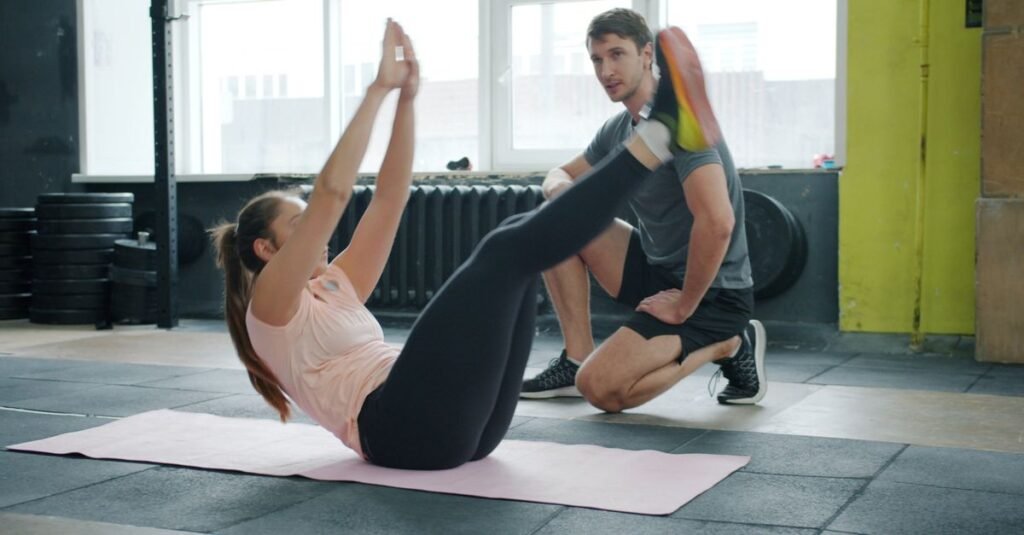
You can start with body-weight exercises on a mat. Equipment can add variety later, but a useful core exercise is one you can perform with steady breathing and a controlled position.
What muscles make up your core?
Think of your core as the muscular support system around the middle of your body. It helps connect upper- and lower-body movement and supports your spine as you move.
The main areas include:
- Abdominal muscles: The muscles across the front and sides of your trunk, including the visible “six-pack” muscles and deeper layers.
- Back muscles: Muscles that help support and control your spine.
- Hip and pelvic muscles: Muscles around your pelvis that contribute to stability and movement.
These muscles work together. When you lift something from the floor, carry a bag or change direction, your trunk needs to manage the forces moving through your body.
That’s why Mayo Clinic describes core exercises more broadly than abdominal exercises alone. An exercise can train your core by asking you to maintain your position, even when your torso barely moves.
Core strength and core stability aren’t quite the same
Core strength generally refers to the ability of these muscles to produce force. Core stability refers to controlling the position and movement of your trunk.
A sit-up involves moving your torso. A plank asks you to resist movement and hold your body steady. Both can count as core exercises, but they create different demands.
The terms overlap, and research doesn’t use one universal definition or test for core stability. For a beginner, the practical point is straightforward: useful core training includes learning to control your body, not just bending at the waist repeatedly.
Are core exercises the same as ab exercises?
Ab exercises are part of core training, but they aren’t the whole thing.
An abdominal exercise focuses mainly on the muscles at the front or sides of your trunk. Core training takes a wider view, including the back, hips and pelvis.
For example, a bridge may feel more demanding in your buttocks than your stomach. It still fits within core training because you’re lifting your hips while controlling your pelvis and trunk.
Likewise, some whole-body exercises require your core to stabilize you even though they’re not labeled “core exercises.” Holding a weight without leaning or twisting can challenge trunk control while other muscles do much of the visible work.
The useful question is what your trunk has to do—not whether the exercise appears on an “abs” list.
What core exercises can help with—and what they can’t
Mayo Clinic identifies balance and stability as important benefits of core training. Stronger, better-controlled trunk muscles may make many everyday tasks and physical activities easier.
But that doesn’t mean more core work always produces better results.
They can support movement, but performance gains vary
Core training can contribute to a well-rounded fitness program. However, a review of athletic research found mixed results for its direct effect on sports performance.
One difficulty is that studies often combine core exercises with other training. If an athlete improves after a broader program, it can be hard to separate the contribution of core work from strength training, conditioning or sport practice.
Use core exercises as one part of your training—not as a guaranteed shortcut to faster running, heavier lifting or injury-free sport.
They don’t selectively remove belly fat
Planks and sit-ups strengthen the muscles beneath the skin. They don’t make your body remove fat specifically from your stomach.
Mayo Clinic distinguishes strengthening abdominal muscles from losing abdominal fat and points to aerobic activity as part of the latter. Core exercises belong alongside broader physical activity, rather than replacing it.
If your goal is a stronger midsection, core work is relevant. If your goal is changing body fat, adding more abdominal exercises alone doesn’t address the whole goal.
They may help some people with low-back pain
A 2022 systematic review found five moderate-quality studies supporting core-stabilization exercise for reducing pain and improving function in people with nonspecific low-back pain—pain that isn’t attributed to a particular identifiable cause.
Other reviews also suggest that core stability exercise can help chronic low-back pain, often as part of a broader therapeutic-exercise program. Conventional exercise can also be beneficial, and some comparisons have limited follow-up evidence.
These findings don’t mean that any plank routine will cure back pain, or that core training is best for every person. If pain is why you’re considering these exercises, get guidance on suitable movements rather than treating a general gym routine as rehabilitation.
Beginner core exercises to try at the gym
Start with movements you can control on a stable surface. You don’t need a stability ball, heavy resistance or a complicated circuit to begin.
Forearm plank: practice holding your trunk steady
A plank challenges your ability to maintain your body position rather than repeatedly moving your torso.
How to do it:
- Place your forearms on a mat, with your elbows beneath your shoulders.
- Extend your legs behind you and support yourself on your toes.
- Gently tighten your abdomen and keep your head, trunk and hips aligned.
- Continue breathing while you hold the position.
Avoid letting your lower back sag or lifting your hips high to escape the effort. Keep your neck in line with your body rather than raising your head to look forward.
Easier option: Keep your knees on the mat. You can also use a stable elevated surface for an incline plank, provided it won’t slide or tip.
End the hold when you can no longer maintain your position. A shorter, controlled plank is more useful for practicing technique than a longer one with sagging hips and held breath.
Bridge: train your hips while controlling your pelvis
A bridge works the hips and buttocks while asking your trunk to stay controlled.
How to do it:
- Lie on your back with your knees bent and feet flat on the floor.
- Rest your arms beside you.
- Gently tighten your abdomen.
- Lift your hips until your shoulders, hips and knees form a roughly straight line.
- Lower your hips with control.
Don’t chase extra height by arching your lower back. The aim is to lift through the hips while keeping the movement comfortable and controlled.
Easier option: Use a smaller lift. If you can maintain control only through part of the movement, start there instead of forcing a higher position.
A bridge illustrates why “core” doesn’t mean only “abs”: several areas around the trunk and pelvis contribute to the exercise.
Sit-up: a moving abdominal exercise, not a requirement
A sit-up trains the abdominal muscles through movement. It’s a familiar option, but you don’t need to include it to have a useful core workout.
How to approach it:
- Lie on a mat with your knees bent and feet on the floor.
- Keep your hands from pulling on your head or neck.
- Lift your torso with control rather than swinging upward.
- Lower without dropping heavily onto the mat.
Easier option: Use a smaller-range abdominal curl, lifting only your head and shoulders rather than attempting a full sit-up.
If the movement causes back or neck pain, stop instead of pushing through it. Another exercise may be more suitable, particularly if you have an existing condition or injury.
Stability-ball exercises: add challenge only when it helps
A stability ball changes the support beneath you, which can increase the demand on balance and trunk control. But an unstable surface isn’t automatically better.
For someone who struggles to control a floor exercise, adding a ball can make it harder to learn the basic movement.
A ball-supported bridge or a plank variation using a ball may be options later. Before trying one, ask a qualified gym instructor to demonstrate the setup and check that the ball and surrounding space are suitable.
Easier option: Perform the equivalent movement on the floor. Progress to the ball when you can manage the stable version without losing position or holding your breath.
How to build a sensible starting session
There isn’t one universal beginner prescription for core exercise. The supplied research doesn’t establish a single set count, repetition target, hold duration, rest period or weekly frequency that suits everyone.
That matters because the same exercise can be easy for one person and too demanding for another.
A practical starting approach is to:
- Choose a small selection. For example, a supported plank and a bridge give you two different tasks: maintaining trunk position and controlling a hip movement.
- Learn the easiest suitable version. Don’t begin with added weight or an unstable surface just because it looks more advanced.
- Watch your movement and breathing. End the effort before you lose control.
- Recover before trying again. Start the next effort when you can reproduce the technique, rather than rushing to keep up with a timer.
- Change one thing at a time. You might gradually extend a controlled hold, add modestly more repetitions or choose a less-supported position.
For a hypothetical beginner, this could mean choosing a knees-down plank because a full plank causes the lower back to sag. Once the supported version feels controlled, that person could try the full version without also adding a longer hold.
A qualified trainer can help select a starting workload and progression. If you need adjustments because of pain or a medical condition, seek a clinician’s advice as well.
Common mistakes that make core training less useful
Choosing difficulty over control
Shaking, swinging or losing your position doesn’t necessarily mean you’re getting a better workout. It may mean the variation exceeds what you can currently control.
Reduce the challenge when your technique deteriorates. That’s a sensible adjustment, not a failed session.
Holding your breath through the effort
For these beginner exercises, keep breathing while gently tightening your trunk. If you have to stop breathing to maintain the position, shorten the effort or use an easier version.
Repeating only one type of exercise
Doing nothing but sit-ups overlooks other parts of the core and other ways it works. Include exercises that challenge control as well as movement, rather than assuming more repetitions of one exercise cover everything.
Replacing the rest of your training with core work
Core exercise is one part of a balanced fitness program. It doesn’t replace aerobic activity, broader strength training or practice for the activities you want to improve.
You don’t need to exhaust your abdomen every time you visit the gym to make core training worthwhile.
Make your first session about technique
At your next gym visit, choose a mat-based bridge and a plank variation you can perform comfortably. Ask a qualified instructor to check your position, and pay attention to whether you can keep breathing and control the movement.
If you have an injury, persistent pain, pregnancy-related concerns or a medical condition, get individualized guidance before choosing exercises or increasing difficulty. This article is educational, not a personal treatment plan.
Your first goal is simple: find a version you can do well. Build the challenge from there.
FAQ
Do core exercises only work the abs?
No. Core training includes muscles in your back, hips and pelvis as well as your abdominal muscles. The muscles work together to support and control your body.
Can core exercises remove belly fat?
No. Planks and sit-ups strengthen the muscles beneath the skin, but they don’t make your body remove fat specifically from your stomach. Core exercises belong alongside broader physical activity.
Which core exercises can a beginner try?
A beginner can start with controlled, stable movements such as a plank variation and a bridge. Choose versions you can perform with steady breathing and good control.
Should I do core exercises if I have back pain?
Some research suggests core-stabilization exercise can help people with nonspecific or chronic low-back pain, often as part of a broader therapeutic-exercise program. If pain is why you’re considering these exercises, get guidance on suitable movements rather than treating a general gym routine as rehabilitation.
Do I need a stability ball to train my core?
No. You can start with body-weight exercises on a mat. A stability ball can add challenge later, but an unstable surface isn’t automatically better.